
Tags column
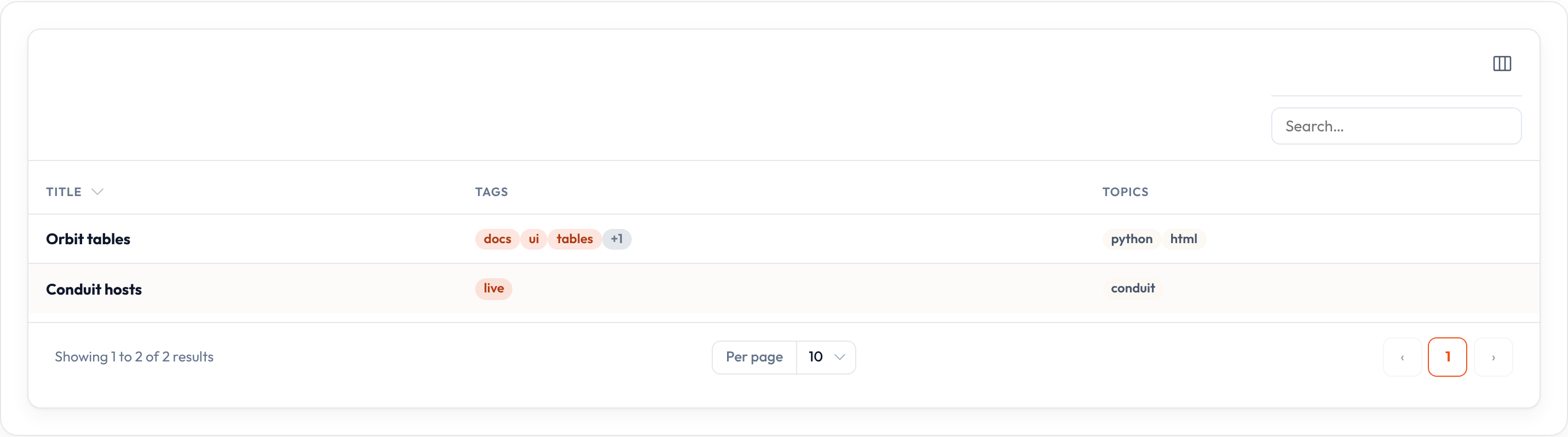
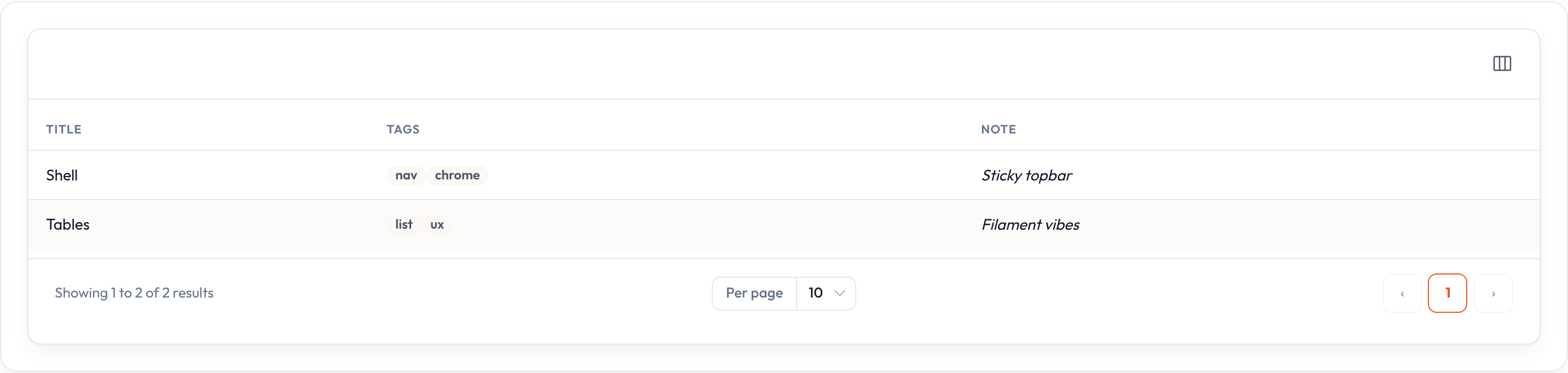
TagsColumn takes an iterable of labels — or a delimited string — and renders each one as a small or-badge chip. It’s built for categories, skills, and other multi-value fields:
from almasix.orbit.tables import TagsColumn
TagsColumn.make("tags")
State can be a list/tuple of strings, or a delimited string such as "docs, ui, tables".
Customizing the separator
Section titled “Customizing the separator”By default, string state is split on commas. Change the delimiter with .separator():
TagsColumn.make("topics").separator(";")Customizing the color
Section titled “Customizing the color”All chips in the column share one color, chosen the same way as TextColumn.color():
TagsColumn.make("tags").color("primary")Limiting the number of tags shown
Section titled “Limiting the number of tags shown”.limit() caps how many chips render before the rest collapse into a +N overflow chip:
TagsColumn.make("tags").limit(3)Full example
Section titled “Full example”from almasix.orbit.tables import Table, TextColumn, TagsColumn
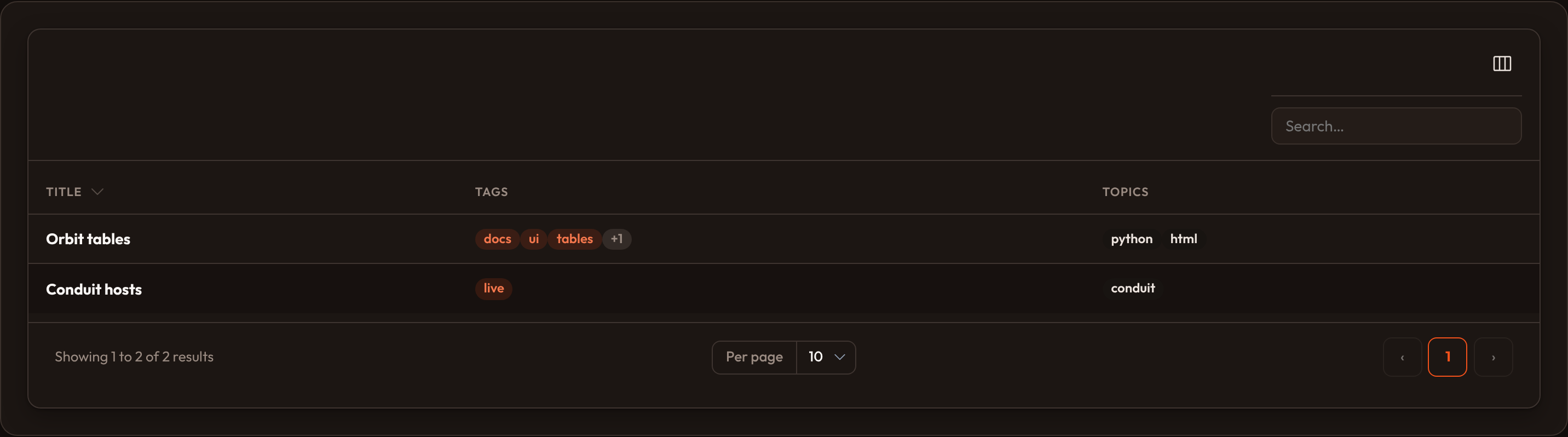
Table.make("articles").columns([ TextColumn.make("title").searchable().sortable().weight("bold"), TagsColumn.make("tags").color("primary").limit(3), TagsColumn.make("topics").separator(";"), # also accepts "python;html" strings]).records([ { "id": 1, "title": "Orbit tables", "tags": ["docs", "ui", "tables", "polish"], "topics": "python;html", }, {"id": 2, "title": "Conduit hosts", "tags": ["live"], "topics": "conduit"},])Empty lists render an empty cell. Pair this column with a TagsInput on the form so create and edit stay in sync with the list.
Key methods
Section titled “Key methods”| Method | Effect |
|---|---|
.separator(char) |
Delimiter used to split string state (defaults to ,) |
.color(str | callable) |
Chip color |
.limit(count) |
Max chips shown before a +N overflow chip |
.format_state_using(callback) |
Normalize dicts / objects → strings before splitting |
.label(...) / .align_start() / .toggleable(...) / .sortable() |
Inherited shared helpers — sorting compares the raw state |
Preview
Section titled “Preview”