

Validation
Introduction
Section titled “Introduction”Orbit validates with Form.validate(data, **ctx), walking nested layouts (Section, Tabs, Wizard, Repeater schemas) via iter_fields. For each visible field with a state path it resolves the value, builds the rule list from Field.get_rules() (injecting required when is_required() is true), then:
- Callable rules — evaluated through
evaluate;True/Nonepass,Falseuses the default invalid message, any other value becomes the error string. - String rules — checked by
_check_ruleinform.py(Laravel-style tokens such asemail,max:255,required_if:role,admin).
Errors return as field_path → [messages]. Database-backed unique / exists need checkers registered with Form.unique_using(...) and Form.exists_using(...) (or passed in **ctx).
Each subsection below includes explanation, a Python example, and screenshots of related form chrome.
Running validation
Section titled “Running validation”Call validate with the submitted (or in-memory) state dict. Invisible fields are skipped. Nested paths use dot notation when reading state.
from almasix.orbit.forms import Form, TextInput
form = Form.make().schema([    TextInput.make('email').required().email().unique('users', 'email'),    TextInput.make('password').required().confirmed(),    TextInput.make('password_confirmation').required(),    TextInput.make('role').default('user'),    TextInput.make('admin_code').required_if('role', 'admin'),])
errors = form.validate({    'email': 'a',    'password': 'x',    'password_confirmation': 'y',    'role': 'admin',})
Attaching rules
Section titled “Attaching rules”.rules(*rules) appends string tokens and/or callables. Fluent helpers below are thin wrappers that call .rules(...) (and sometimes set input type). Empty values skip most rules except presence-style ones (required, filled, accepted, and the conditional required/prohibited family).
TextInput.make('sku') .rules('alpha_dash', 'max:32') .rules(lambda value, **_: True if value != 'root' else 'SKU is reserved.')

Required and mark as required
Section titled “Required and mark as required”.required(condition=True) accepts a bool or callable and injects a required rule when true at validation time. .mark_as_required() only controls the asterisk via shows_required_asterisk() without adding a rule — useful when validation is conditional but the UI should still look mandatory (or the reverse).
TextInput.make('title')    .label('Title')    .required()
TextInput.make('slug')    .label('Slug')    .mark_as_required()    .required(lambda data=None, **_: bool((data or {}).get('publish')))

Length helpers
Section titled “Length helpers”| Helper | Rule token | Enforced by Form.validate today |
|---|---|---|
.min_length(n) |
min:n |
Yes (numeric or string length) |
.max_length(n) |
max:n |
Yes |
.length(n) |
size:n |
Fluent registers the rule; prefer min/max until size: is handled |
.between(lo, hi) |
between:lo,hi |
Yes (number or string length) |
TextInput.make('username')    .min_length(3)    .max_length(30)    .between(3, 30)
TextInput.make('pin')    .length(4)

Email, URL, numeric, integer, tel
Section titled “Email, URL, numeric, integer, tel”.email(), .url(), and .numeric() set the HTML input type and append matching rules. .integer() chains numeric + integer. .tel() only sets type="tel" — add .tel_regex(pattern) or .regex(pattern) for format checks (regex: is enforced).
TextInput.make('email').email().required()TextInput.make('website').url()TextInput.make('quantity').numeric().min_value(0)TextInput.make('count').integer()TextInput.make('phone').tel().tel_regex(r'^\+?[0-9\s\-]+$')

.regex(pattern) and .tel_regex(pattern) both append regex:{pattern}. Patterns are tested with re.search (not fullmatch) against the string value.
TextInput.make('slug') .regex(r'^[a-z0-9\-]+$')

Unique and exists
Section titled “Unique and exists”.unique(table, column=None, ignore=None) builds unique:table,column,ignore. .exists(table, column=None) builds exists:table,column. Register checkers once:
Form.unique_using(lambda value, table, column, **ctx: not db.exists(table, column, value, ignore=ctx.get('ignore')))Form.exists_using(lambda value, table, column, **ctx: db.exists(table, column, value))TextInput.make('email') .email() .unique('users', 'email', ignore=lambda **ctx: ctx.get('record_id'))
TextInput.make('country_id') .exists('countries', 'id')

Distinct
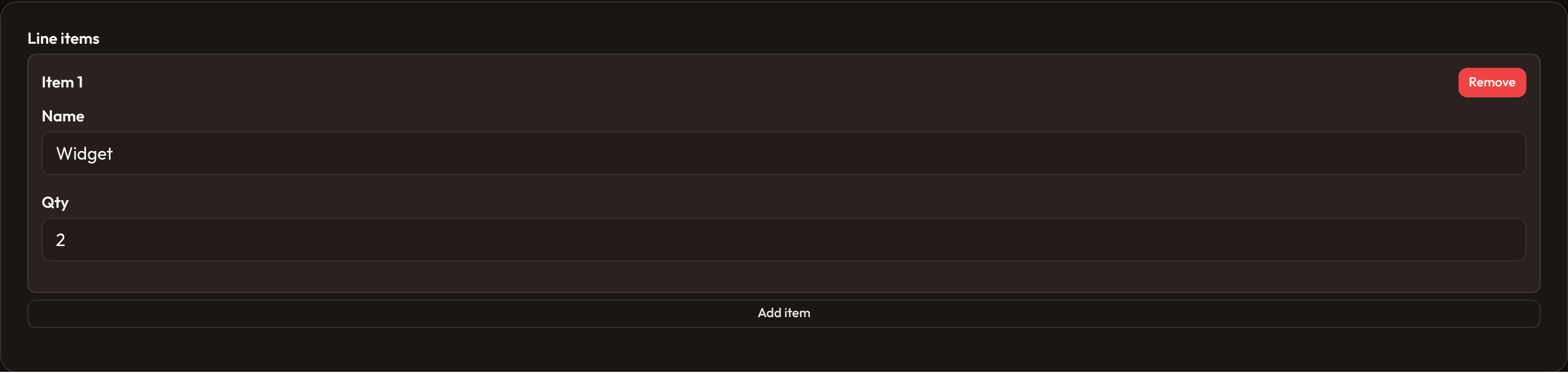
Section titled “Distinct”.distinct() appends distinct. Enforcement expects sibling values in validation context when the host provides them; otherwise the rule may no-op. Use for repeater rows that must not repeat a key.
TextInput.make('sku') .distinct()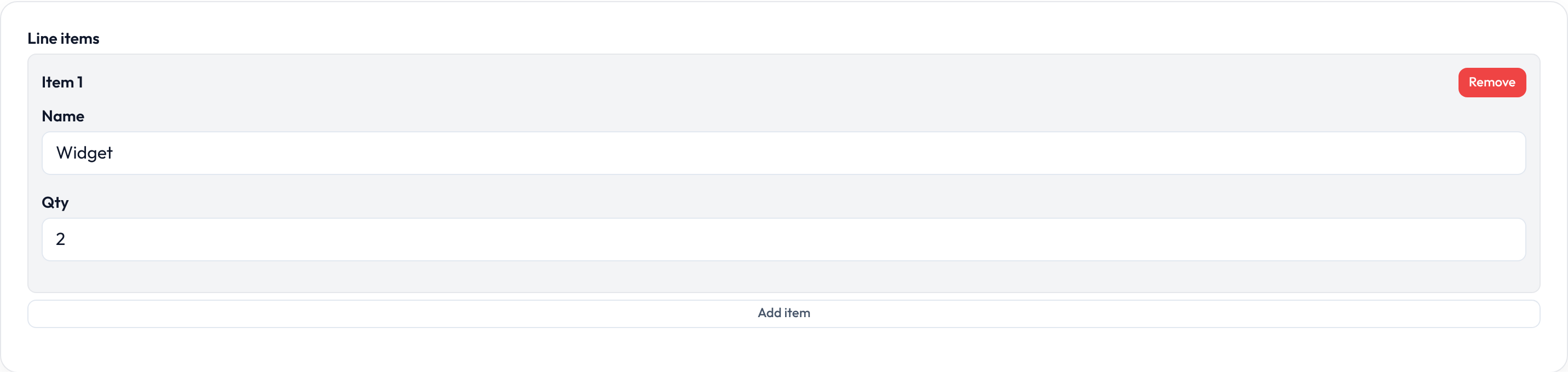
Conditional required
Section titled “Conditional required”| Helper | Rule |
|---|---|
.required_if(field, value) |
required_if:field,value |
.required_unless(field, value) |
required_unless:field,value |
.required_with(*fields) |
required_with:a,b |
.required_with_all(*fields) |
required_with_all:a,b |
.required_without(*fields) |
required_without:a,b |
.required_without_all(*fields) |
required_without_all:a,b |
.required_if_accepted(field) |
required_if_accepted:field |
required_if / required_unless are enforced today. The required_with* / required_if_accepted helpers register rule tokens for hosts and future _check_rule coverage — prefer callable .required(lambda state, **_: …) when you need guaranteed enforcement of complex sibling logic now.
TextInput.make('admin_code')    .required_if('role', 'admin')
TextInput.make('company')    .required_unless('account_type', 'personal')
TextInput.make('vat_number')    .required_with('company')

Prohibited
Section titled “Prohibited”| Helper | Rule |
|---|---|
.prohibited() |
prohibited |
.prohibited_if(field, value) |
prohibited_if:field,value |
.prohibits(*fields) |
prohibits:a,b |
prohibited / prohibited_if are enforced. .prohibits() registers the token for hosts and future enforcement; use a callable rule if you must block sibling fields today.
TextInput.make('guest_note')    .prohibited_if('role', 'admin')
TextInput.make('legacy_code')    .prohibited()

Confirmed, same, different
Section titled “Confirmed, same, different”.confirmed() expects {path}_confirmation to match. .same(field) / .different(field) compare against another state path — all three are enforced.
TextInput.make('password').password().confirmed()TextInput.make('password_confirmation').password()TextInput.make('email').same('email_confirmation')TextInput.make('backup_email').different('email')

Filled and present
Section titled “Filled and present”.filled() requires a non-empty value (enforced). .present() registers the present token for hosts and future _check_rule coverage; prefer .filled() or .required() when you need enforcement today.
TextInput.make('display_name') .filled()

String character classes
Section titled “String character classes”| Helper | Rule | Enforced |
|---|---|---|
.alpha() |
alpha |
Yes |
.alpha_num() |
alpha_num |
Yes |
.alpha_dash() |
alpha_dash |
Yes |
.ascii() |
ascii |
Token registered |
.starts_with(*values) |
starts_with:a,b |
Yes |
.ends_with(*values) |
ends_with:a,b |
Yes |
.doesnt_start_with(*values) |
doesnt_start_with:… |
Token registered |
.doesnt_end_with(*values) |
doesnt_end_with:… |
Token registered |
TextInput.make('code') .alpha_dash() .starts_with('sku-', 'SKU-') .doesnt_end_with('-tmp')

Network and identity formats
Section titled “Network and identity formats”| Helper | Rule | Enforced |
|---|---|---|
.ip() |
ip |
Yes (loose v4/v6) |
.ipv4() / .ipv6() |
ipv4 / ipv6 |
Tokens registered |
.mac_address() |
mac_address |
Token registered |
.url() / .active_url() |
url / active_url |
url yes; active_url token |
.uuid() / .ulid() |
uuid / ulid |
uuid yes; ulid token |
.json() |
json |
Yes |
.hex_color() |
hex_color |
Token registered |
TextInput.make('host').ip()TextInput.make('webhook').url().active_url()TextInput.make('id').uuid()TextInput.make('payload').json()ColorPicker.make('tint') # native color; or TextInput.make('tint').hex_color()

Numeric extras
Section titled “Numeric extras”.multiple_of(value) registers multiple_of:{value}. .between(), .min_value() / .max_value() (HTML attrs) and raw .rules('gt:…') etc. cover ranges. _check_rule also understands raw gt:, gte:, lt:, lte:, digits:, in:, not_in: via .rules(...) without dedicated fluent wrappers.
TextInput.make('quantity') .integer() .multiple_of(5) .rules('gte:5', 'lte:100')

Date comparison helpers
Section titled “Date comparison helpers”| Helper | Rule | Enforced |
|---|---|---|
.after(date_or_field) |
after:… |
Yes |
.before(date_or_field) |
before:… |
Yes |
.after_or_equal(…) |
after_or_equal:… |
Token registered |
.before_or_equal(…) |
before_or_equal:… |
Token registered |
.date_equals(…) |
date_equals:… |
Token registered |
Bounds may be ISO date strings or sibling field names. Raw .rules('date') is enforced when you need type checking without a fluent helper.
DatePicker.make('starts_on').required()DatePicker.make('ends_on') .after('starts_on') .before_or_equal('2027-01-01')

Validation attribute and messages
Section titled “Validation attribute and messages”.validation_attribute('Email address') replaces the attribute name in messages. .validation_messages({key: template}) overrides per-rule templates. Placeholders :attribute / {attribute} and named :key / {key} are substituted by format_validation_message().
TextInput.make('email') .email() .required() .validation_attribute('Email address') .validation_messages({ 'required': 'Please enter an :attribute.', 'email': 'That :attribute does not look valid.', })Callable rules cookbook
Section titled “Callable rules cookbook”Return True/None to pass, False for the default invalid message, or a string for a custom message. Signatures can request value, state, field, attribute, operation, and any host-provided utilities.
TextInput.make('slug') .rules(lambda value, state=None, **_: ( True if not value or value not in (state or {}).get('reserved', []) else 'That slug is reserved.' ))Complete fluent helper index
Section titled “Complete fluent helper index”Helpers that exist on Field today (Orbit Python API — not PHP). Chain freely; each returns Self.
TextInput.make('email') .required() .email() .max_length(255) .unique('users', 'email') .validation_attribute('Email address') .validation_messages({'unique': 'That :attribute is taken.'})Fluent helpers: required, mark_as_required, rules, email, url, numeric, integer, tel (type only), password (type only), min_length, max_length, length, between, regex, tel_regex, unique, exists, distinct, required_if, required_unless, required_with, required_with_all, required_without, required_without_all, required_if_accepted, prohibited, prohibited_if, prohibits, confirmed, same, different, filled, present, alpha, alpha_num, alpha_dash, ascii, starts_with, ends_with, doesnt_start_with, doesnt_end_with, ip, ipv4, ipv6, mac_address, active_url, uuid, ulid, json, hex_color, multiple_of, after, after_or_equal, before, before_or_equal, date_equals, validation_attribute, validation_messages, format_validation_message.
Raw tokens useful via .rules(...) without fluent wrappers: nullable, accepted, boolean, array, date, in:, not_in:, digits:, gt:, gte:, lt:, lte:, max:, min:, mimes: (when host checks files).
See also Form closures for conditional required/visibility and Custom fields for adding rules on subclasses.