

Overview
A resource is one admin surface for a model. It owns the form (create/edit), table (index), optional infolist (view), permissions, and the usual index / create / edit / view routes. Register the resource class on a panel; Orbit mounts the pages under the panel path.
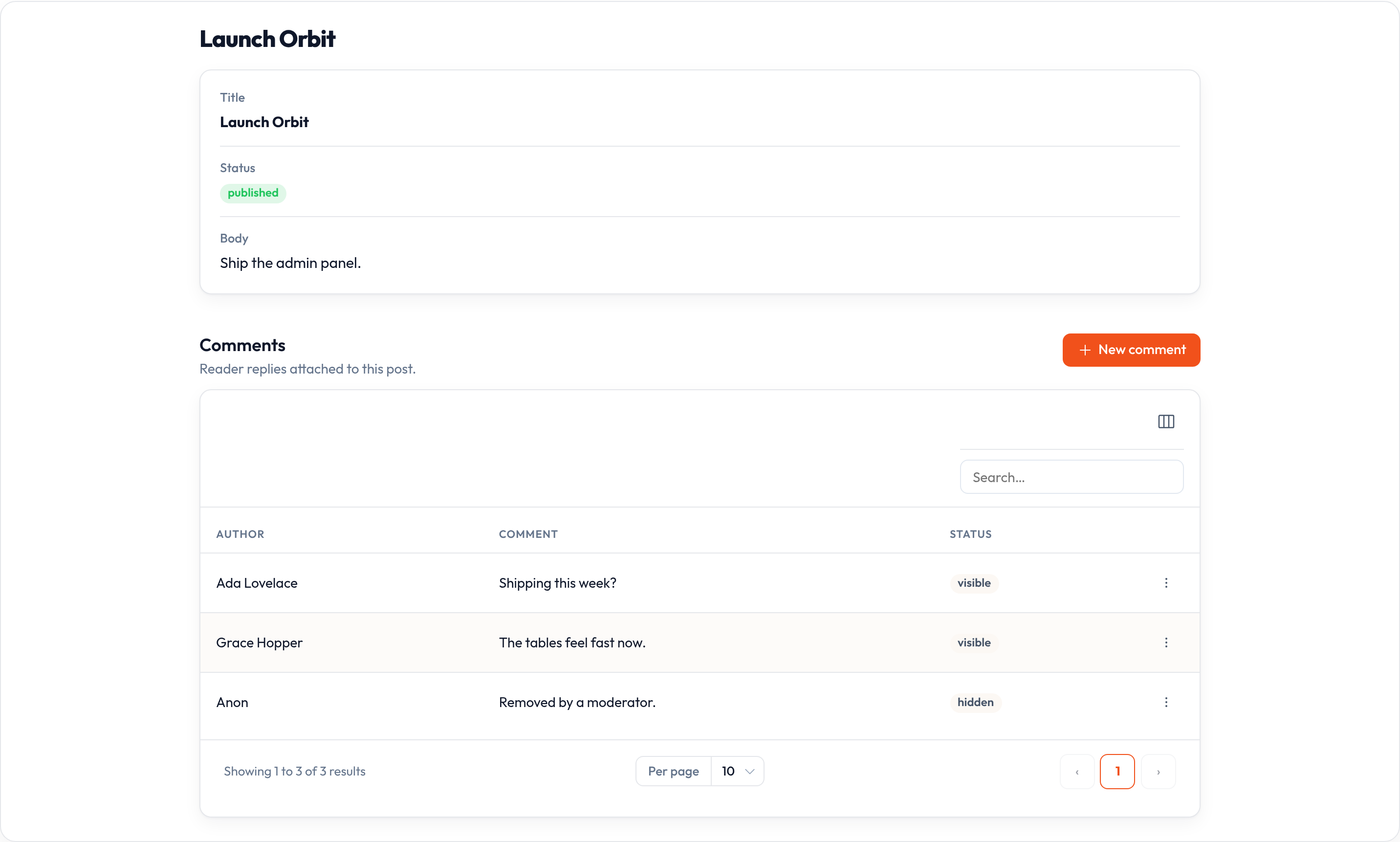
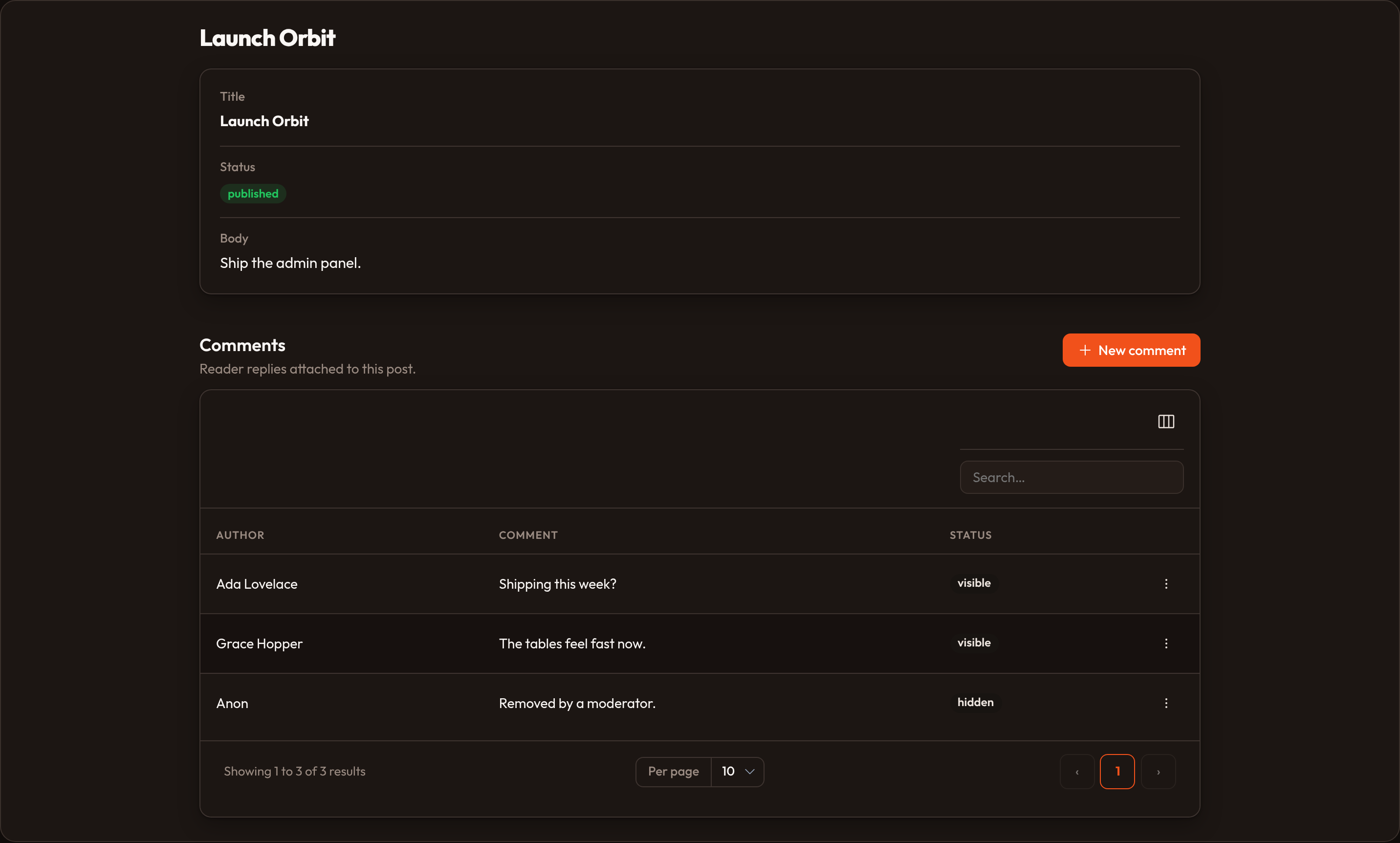
from almasix.orbit import Resourcefrom almasix.orbit.forms import Form, TextInputfrom almasix.orbit.tables import Table, TextColumnfrom almasix.orbit.infolists import Infolist, TextEntry

class PostResource(Resource):    model = Post    slug = "posts"                       # optional — defaults to plural snake of the class    navigation_label = "Posts"    navigation_group = "Content"    navigation_sort = 1    navigation_icon = "heroicon-o-pencil-square"    permission_prefix = "posts"          # optional — defaults to slug    record_title_attribute = "title"
    @classmethod    def form(cls, form: Form) -> Form:        return form.schema([            TextInput.make("title").required(),            TextInput.make("slug").required(),        ])
    @classmethod    def table(cls, table: Table) -> Table:        return table.columns([            TextColumn.make("title").searchable().sortable(),        ])
    @classmethod    def infolist(cls, infolist: Infolist) -> Infolist:        return infolist.schema([            TextEntry.make("title"),            TextEntry.make("slug").copyable(),        ])
    @classmethod    def get_relations(cls) -> list[type]:        return [CommentsRelationManager]
Class vars
Section titled “Class vars”| Var | Default | Role |
|---|---|---|
model |
None |
Articulate (or other) model class |
slug |
plural of class name | URL segment; strips trailing Resource, snake_case + plural (AuthorResource → authors). Set slug = "..." to override. |
navigation_* |
sensible defaults | Sidebar label, icon, group, sort |
record_title_attribute |
"id" |
How records introduce themselves |
model_label / plural_model_label |
derived from slug | Singular / plural wording in page headings |
global_search_attributes |
() |
Attributes matched by global search |
global_search_result_details |
() |
Attributes shown under a search result |
global_search_result_limit |
5 |
Most results this resource contributes |
soft_deletes |
False |
Adds a trashed filter plus restore / force-delete actions |
permission_prefix |
slug | Ability prefix |
Record titles
Section titled “Record titles”record_title_attribute names the field that identifies a record. Orbit uses it for the view and edit page headings, the last breadcrumb, and global search results:
PostResource.get_record_title({"id": 3, "title": "Launch Orbit"}) # "Launch Orbit"PostResource.get_record_title({"id": 3, "title": ""}) # "Post #3"Override get_record_title(record) when the title is computed from several fields.
Configure hooks
Section titled “Configure hooks”| Hook | Returns |
|---|---|
form(form) |
Configured Form |
table(table) |
Configured Table |
infolist(infolist) |
Configured Infolist |
get_relations() |
Relation manager classes |
Call Resource.get_form(), get_table(), or get_infolist() when you need the built instance.
Scaffolding (make:orbit-resource)
Section titled “Scaffolding (make:orbit-resource)”smith make:orbit-resource Post --panel=adminsmith make:orbit-resource Post --model=Post --generate# or: smith orbit:resource Post -G --model=app.models.post.Post| Option | Role |
|---|---|
--panel= |
Target panel package (app/orbit/{id}/resources/) |
--model= |
ORM model (bare Post or app.models.post.Post); also guessed from the resource name |
--generate / -G |
Reflect Schema.columns on the model’s table and stub form fields + table columns |
--force |
Overwrite an existing file |
Without --generate, the stub still uses a title TextInput / TextColumn. When a model resolves and the CLI is interactive, Orbit asks whether to generate from the database. Review and adjust the guessed types afterward (especially enums and relationships).
Default table actions
Section titled “Default table actions”If you leave action slots empty, get_table() wires:
- Row: View, Edit, Delete
- Bulk: Delete selected
- Header: Create
Override anytime:
@classmethoddef table(cls, table: Table) -> Table: return ( table.columns([TextColumn.make("title")]) .header_actions([CreateAction.make()]) .actions([EditAction.make(), DeleteAction.make()]) .bulk_actions([DeleteBulkAction.make()]) )Pages map
Section titled “Pages map”PostResource.get_pages()# {# "index": "/posts",# "create": "/posts/create",# "edit": "/posts/{id}/edit",# "view": "/posts/{id}",# }Wire these into your router however your app mounts Orbit. The resource owns the shape; the app owns the HTTP.
Permissions
Section titled “Permissions”Abilities are {prefix}.view_any, .view, .create, .update, .delete.
PostResource.can_view_any(user)PostResource.can_create(user)PostResource.can_update(user, record)PostResource.can_delete(user, record)Resolution order looks for can / has_permission / hasPermissionTo, then admin flags, then a permissions set/list (including "*"). Pair with almasix-permission for the real deal.
Relations
Section titled “Relations”Return relation manager classes from get_relations(). Orbit renders each one on the view and edit pages — see Relation managers.
Soft deletes
Section titled “Soft deletes”class PostResource(Resource): soft_deletes = TrueThe default table gains a trashed filter (“Without trashed” / “With trashed” / “Only trashed”) and restore plus force-delete row actions that appear only on trashed rows. List and view hosts learn the restore action, which calls the model’s restore() when it has one and otherwise clears deleted_at.
Global search
Section titled “Global search”Declare global_search_attributes and the resource joins the panel’s topbar search box — see Global search.
Next: Listing records, Forms, Tables, Infolists.