

Relation managers
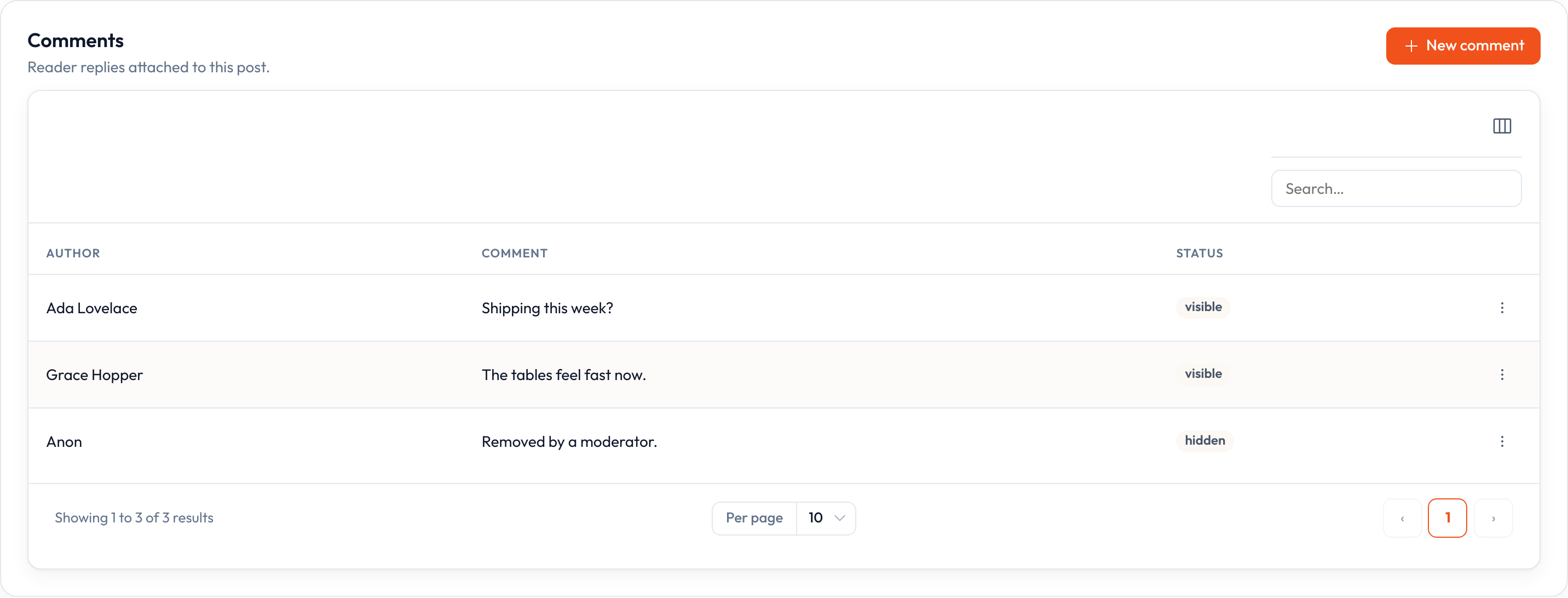
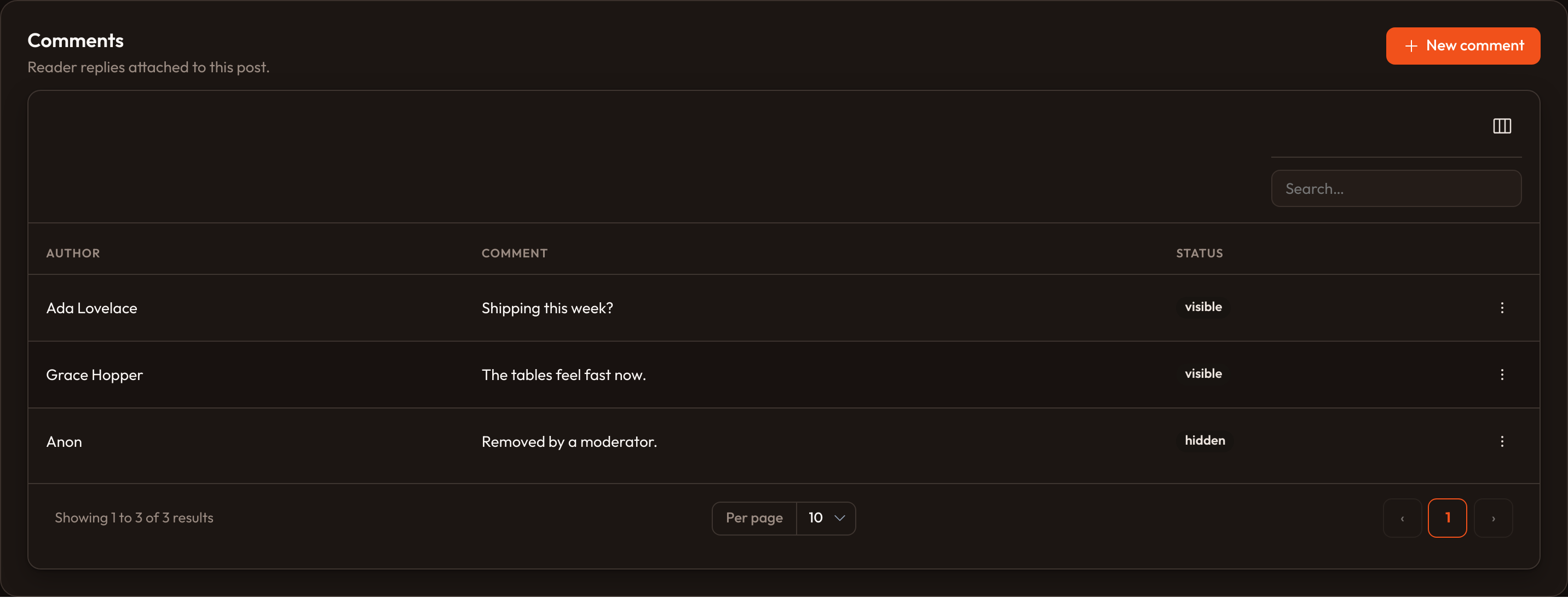
A relation manager is a table of records that belong to the record you are looking at: comments on a post, line items on an order, members of a team. You declare it once, attach it to the owning resource, and Orbit renders it underneath the infolist on the view page and underneath the form on the edit page.
Write one
Section titled “Write one”Subclass RelationManager, name the relationship, and configure the table (and, if the rows are editable, a form):
from almasix.orbit import RelationManagerfrom almasix.orbit.forms import Form, Select, TextInput, Textareafrom almasix.orbit.tables import BadgeColumn, Table, TextColumn
from app.models.comment import Comment

class CommentsRelationManager(RelationManager):    relationship = "comments"    title = "Comments"    description = "Reader replies attached to this post."    record_title_attribute = "author"    related_model = Comment    foreign_key = "post_id"
    @classmethod    def form(cls, form: Form) -> Form:        return form.schema([            TextInput.make("author").required().max_length(80),            Textarea.make("body").rows(3).required(),            Select.make("status").options({"visible": "Visible", "hidden": "Hidden"}),        ])
    @classmethod    def table(cls, table: Table) -> Table:        return table.columns([            TextColumn.make("author").searchable().sortable(),            TextColumn.make("body").limit(60).wrap(),            BadgeColumn.make("status").colors({"visible": "success", "hidden": "gray"}),        ])
Attach it to the resource that owns the records:
class PostResource(Resource):    model = Post
    @classmethod    def get_relations(cls) -> list[type]:        return [CommentsRelationManager]
That is the whole wiring step. The view and edit pages pick the managers up from get_relations(); you do not render them by hand.
Where the rows come from
Section titled “Where the rows come from”Orbit resolves related records in one of two ways:
| Setup | How rows load |
|---|---|
related_model is an ORM model |
Queries related_model.where(foreign_key, owner_id) when the page mounts |
No related_model |
Reads owner["comments"] (dict records) or owner.comments (objects) |
foreign_key defaults to the owning resource’s singular slug plus _id — a PostResource with slug posts looks for post_id. Set it explicitly when your column is named differently.
The second form is handy for demos and for records you already loaded: any list on the owner works, no database required.
Configuration
Section titled “Configuration”| Class var | Role | Default |
|---|---|---|
relationship |
Attribute / dict key holding the rows, and the manager’s identity in action names | — |
title |
Heading above the table | Title-cased relationship |
description |
Sentence under the heading | None |
record_title_attribute |
How a related row introduces itself | "id" |
related_model |
ORM model to query | None |
foreign_key |
Column pointing back at the owner | {owner}_id |
render_on |
"view", "edit", or "both" |
"both" |
is_mutable |
Adds create / delete chrome to the table | True |
Set render_on = "edit" for managers that only make sense while editing (revision history, internal notes), and is_mutable = False for read-only lists such as audit logs:
class RevisionsRelationManager(RelationManager): relationship = "revisions" render_on = "edit" is_mutable = FalseActions
Section titled “Actions”A mutable manager renders a New <record> header action and a delete row action. Both are namespaced so the page host can route them back to the right manager:
relation.comments.createrelation.comments.deleteDeleting a row removes it from the related model (ORM) or from the loaded rows (in-memory), and the page re-renders without a full reload. Every relation action also dispatches an orbit-relation-action browser event carrying the relationship, action, and record id, so custom JavaScript can react.
Supply your own actions when the defaults do not fit — anything you set in table() wins:
@classmethoddef table(cls, table: Table) -> Table: return table.columns([...]).actions([ Action.make("approve").icon("heroicon-o-check").color("success"), ])Authorization
Section titled “Authorization”class CommentsRelationManager(RelationManager): @classmethod def can_view_for_record(cls, user, owner) -> bool: return user.can("posts.moderate", owner)The page calls can_view_for_record(user, owner) for every manager before rendering it. With no signed-in user the manager renders (so panels work before you register policies); with a user, a False result hides the section entirely.
Related pages
Section titled “Related pages”- Resources overview — the class that owns the managers
- Viewing records and Editing records — the pages managers appear on
- Tables — every column, filter, and action available inside a manager