

Editing records
The edit page lives at {resource}/{id}/edit. It loads the record, fills the resource form with its values, and titles the page with the record itself — Edit Launch Orbit rather than Edit Posts.
Loading the record
Section titled “Loading the record”When the page mounts, Orbit finds the record by id — through the ORM model for database-backed resources, or from the resource’s seed list — and hydrates the form field by field. Nested keys the schema does not cover (wizard bags, JSON columns) are kept in state so they survive a save.
The heading comes from record_title_attribute:
class PostResource(Resource): record_title_attribute = "title" # heading + breadcrumb leafOverride get_record_title(record) for a computed title:
@classmethoddef get_record_title(cls, record) -> str: return f"{record['reference']} — {record['customer']}"The breadcrumb trail shows the same title and links it to the record’s view page.
Saving
Section titled “Saving”Submitting the form validates the schema, writes the changes (ORM update or in-memory replace), dispatches orbit-record-saved, and redirects to the record’s view page. A resource whose records are not mutable renders a read-only copy of the form with a short explanation instead.
Header actions
Section titled “Header actions”The edit page shows View and Delete buttons by default. They are permission-aware: with a signed-in user, can_view and can_delete decide whether each appears; before you register policies everything stays visible so a fresh panel is usable.
Relation managers
Section titled “Relation managers”Every relation manager with render_on set to "edit" or "both" renders below the form, so a post’s comments can be managed while the post itself is being edited:
class PostResource(Resource): @classmethod def get_relations(cls) -> list[type]: return [CommentsRelationManager]Soft deletes
Section titled “Soft deletes”Turn on soft_deletes and the resource’s table gains a trashed filter plus restore and force-delete actions, and the page hosts learn the restore action:
class PostResource(Resource): soft_deletes = True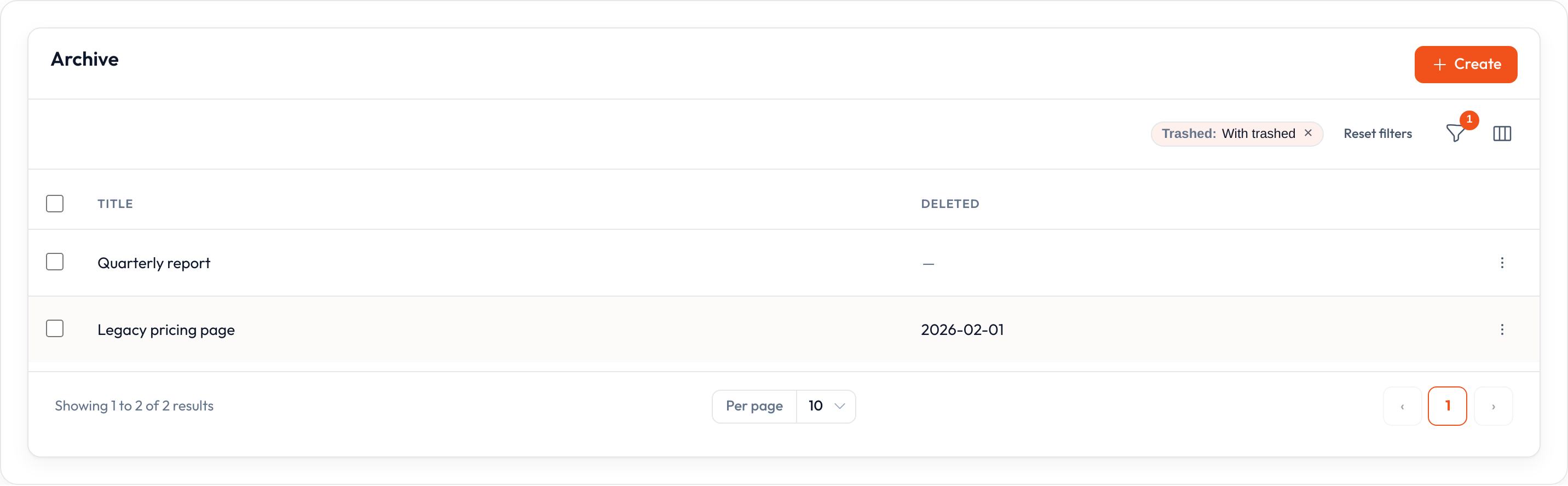

Restoring calls the model’s restore() when it has one, and otherwise clears deleted_at.
Related pages
Section titled “Related pages”- Creating records — the same schema before the record exists
- Viewing records — the read-only counterpart
- Relation managers — nested tables on this page